

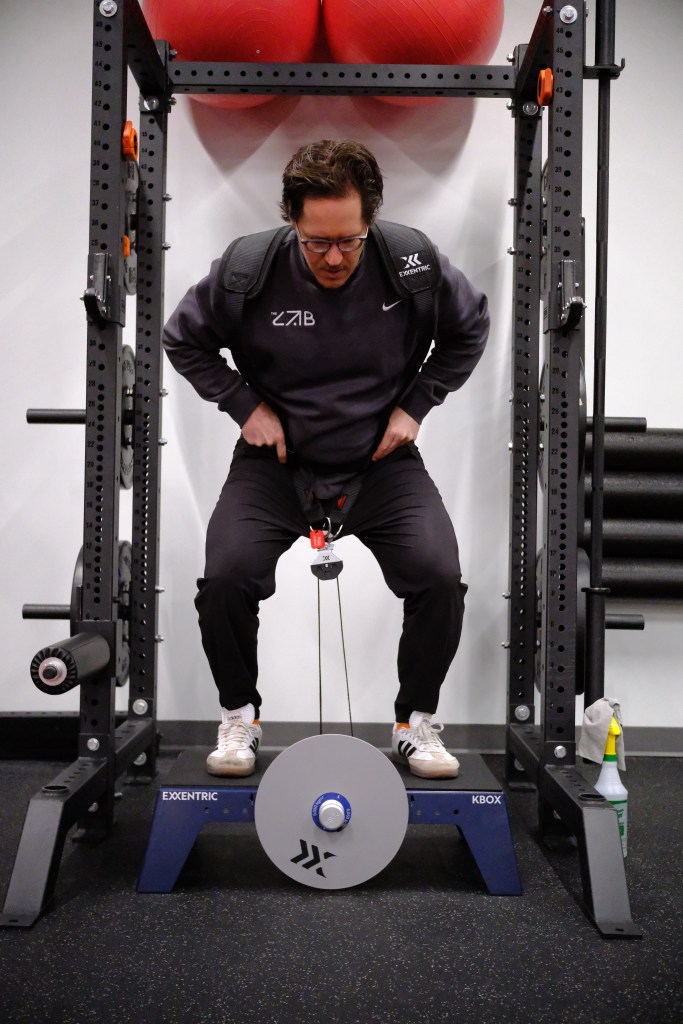
In the evolving world of sports rehabilitation and performance training, flywheel training has gained recognition for its ability to enhance strength, power, and muscle adaptation. Flywheel, or inertia training, relies on rotational inertia rather than gravity to provide resistance—essentially spinning a weighted disc. If you’ve never seen or heard of it before, it might be hard to picture.

Inertia training has demonstrated significant benefits for both injury recovery and athletic performance. In ACL recovery, hitting specific milestones is key to progressing toward a return to play and a return to sport. This is where flywheel training becomes a valuable tool for recovering ACL athletes. In some cases, it outperforms traditional resistance training due to the way load is applied to the muscles and joints.
What is Flywheel Training?
Flywheel training utilizes a rotating disc to provide continuous resistance throughout the movement. Unlike traditional weight training, where resistance decreases at certain phases of an exercise, flywheel resistance remains constant, allowing for greater eccentric overload. Studies have shown its effectiveness in increasing muscular strength and hypertrophy, improving power and speed, enhancing tendon stiffness and muscle activation, and boosting change-of-direction ability and jump height.
Flywheel Training in ACL Rehabilitation
Athletes recovering from an ACL injury require a structured rehab program to regain strength, stability, and neuromuscular control. Flywheel training has been shown to positively impact many aspects of ACL recovery. Research suggests it can improve quadriceps strength and rate of force development, enhance knee control and symmetry in return-to-sport athletes, and reduce asymmetries in knee biomechanics, which are common after ACL reconstruction.
Key Research Findings
Henderson et al. (2022) found that 16 sessions of Bulgarian split squats to exhaustion on a flywheel training system improved quadriceps strength at deeper knee flexion angles, reduced strength imbalances between limbs (Limb Symmetry Index), and was safe to implement with ACLR athletes with no reported adverse effects. The key to success was progressive overload as tolerated, starting with inertial resistance of 0.025 kg·m² for females and 0.050 kg·m² for males.
Henderson and Shimokochi (2025) found that 16 sessions of rear foot elevated flywheel training improved jump height in the reconstructed leg, restored normal knee mechanics with a decreased reliance on hip mechanics, and eliminated asymmetry in knee joint loading.
When to Introduce Flywheel Training After ACL Surgery
Flywheel training can be integrated into rehabilitation at different stages, but timing is key.
Early Stages (0–3 weeks post-op)
-Focus on isometric quadriceps activation
– No flywheel training at this stage
Early/Mid Stages (3–6 weeks post-op)
– Begin light eccentric quadriceps training
-Introduce flywheel training gradually
Mid/Late Stages (6+ weeks post-op)
– Incorporate progressive overload with flywheel training
-Combine with plyometrics, agility drills, and sport-specific tasks
***This is to be structured by a rehabilitation expert and depends heavily on the type of injury, type of surgery, and achieving injury specific milestones in the recovery journey
Clinical Guidelines for Flywheel Training
Frequency & Duration
-
- 6–12 weeks for strength and hypertrophy gains
-
- 2–3 sessions per week recommended
Intensity
-
- Typically >0.05 kg·m² inertia for strength adaptations
-
- Female athletes: 0.025–0.14 kg·m² inertia range
Exercise Selection
-
- Squats on flywheel devices → improves power and jump performance
-
- Bulgarian split squats → strengthens quadriceps and reduces asymmetries

Benefits of Flywheel Training for Uninjured Athletes
There is growing evidence supporting the use of flywheel training for injury reduction. Soccer players who performed a 10-week flywheel program including squat and leg curl exercises experienced a significant decrease in lower-limb muscle injuries during the season (Perna, 2024).
Volleyball athletes who completed a six-week flywheel training program compared to those who performed only bodyweight exercises showed positive adaptations in hamstring peak power, jump assessments, valgus control, and repeated shuttle sprint performance—key factors in ACL injury prevention. These athletes also had fewer lower limb injuries during their season
Flywheel and inertia training also appear to have positive effects on tendon health by increasing tendon cross-sectional area. Studies suggest benefits across multiple tendons, including the Achilles tendon, patellar tendon, shoulder rotator cuff, in cases of subacromial pain syndrome, and elbow tendinopathies such as lateral and medial epicondylitis.
FLYnal Thoughts
Flywheel training is a powerful tool for ACL rehabilitation and athletic development. When introduced at the right time, it can accelerate recovery, improve strength imbalances, and optimize performance. By integrating flywheel exercises into a structured rehab plan, clinicians and coaches can help athletes return to sport stronger and more resilient than before.
Radek Wiechecki
Physiotherapist
References
References:
-
- Beato, M., De Keijzer, K. L., Muñoz-Lopez, A., Raya-González, J., Pozzo, M., Alkner, B. A., … & Norrbrand, L. (2024). Current guidelines for the implementation of flywheel resistance training technology in sports: A consensus statement. Sports Medicine, 54(3), 541-556.
-
- Henderson, F. J., Konishi, Y., Shima, N., & Shimokochi, Y. (2022). Effects of 8-week exhausting deep knee flexion flywheel training on persistent quadriceps weakness in well-trained athletes following anterior cruciate ligament reconstruction. International Journal of Environmental Research and Public Health, 19(20), 13209.
-
- Henderson, F. J., & Shimokochi, Y. (2025). Inertial one-leg squat training and drop jump biomechanics in athletes with anterior cruciate ligament reconstruction after return to sport. The Journal of Strength & Conditioning Research, 39(2), 156-164.
-
- Monajati, A., Larumbe-Zabala, E., Goss-Sampson, M., & Naclerio, F. (2021). Injury prevention programs based on flywheel vs. body weight resistance in recreational athletes. The Journal of Strength & Conditioning Research, 35, S188-S196.
-
- Patra, R. C., Gupta, S., & Mahajan, S. (2024). The impact of isoinertial eccentric strength training on knee-related quality of life and function: An experimental trial in post-ACL reconstruction patients.
-
- Perna, P., de Keijzer, K. L., & Beato, M. (2024). Flywheel resistance training in football: A useful rehabilitation tool for practitioners. Frontiers in Sports and Active Living, 6, 1434995.
-
- Wonders, J. (2019). Flywheel training in musculoskeletal rehabilitation: A clinical commentary. International Journal of Sports Physical Therapy, 14(6), 994.